Off the trailNumber 02Visual design
Mineral Palimpsest
A story about oysters, polluted coastlines, and towers cast from shells.
- Kind
- Narrative, illustration, fabrication
- Made with
- Drawing, CNC-milled reliefs, cast models
- The premise
- One oyster filters 50 gallons of water a day
Visual design
Drawings, renderings and stories from architecture school: speculative buildings and the worlds they sit in.
A speculative story in which architecture and the sea look after each other, and the oyster is the link between them.
An oyster is a filter. A single one draws about 50 gallons of water a day over its gills, trapping plankton and, with it, carbon and the nutrients that cause coastal dead zones. Its shell is mostly calcite, which can be milled and cast like concrete. Early Spanish settlers in Florida and the Carolinas burned oyster shells for lime and built with the result, a material called tabby.
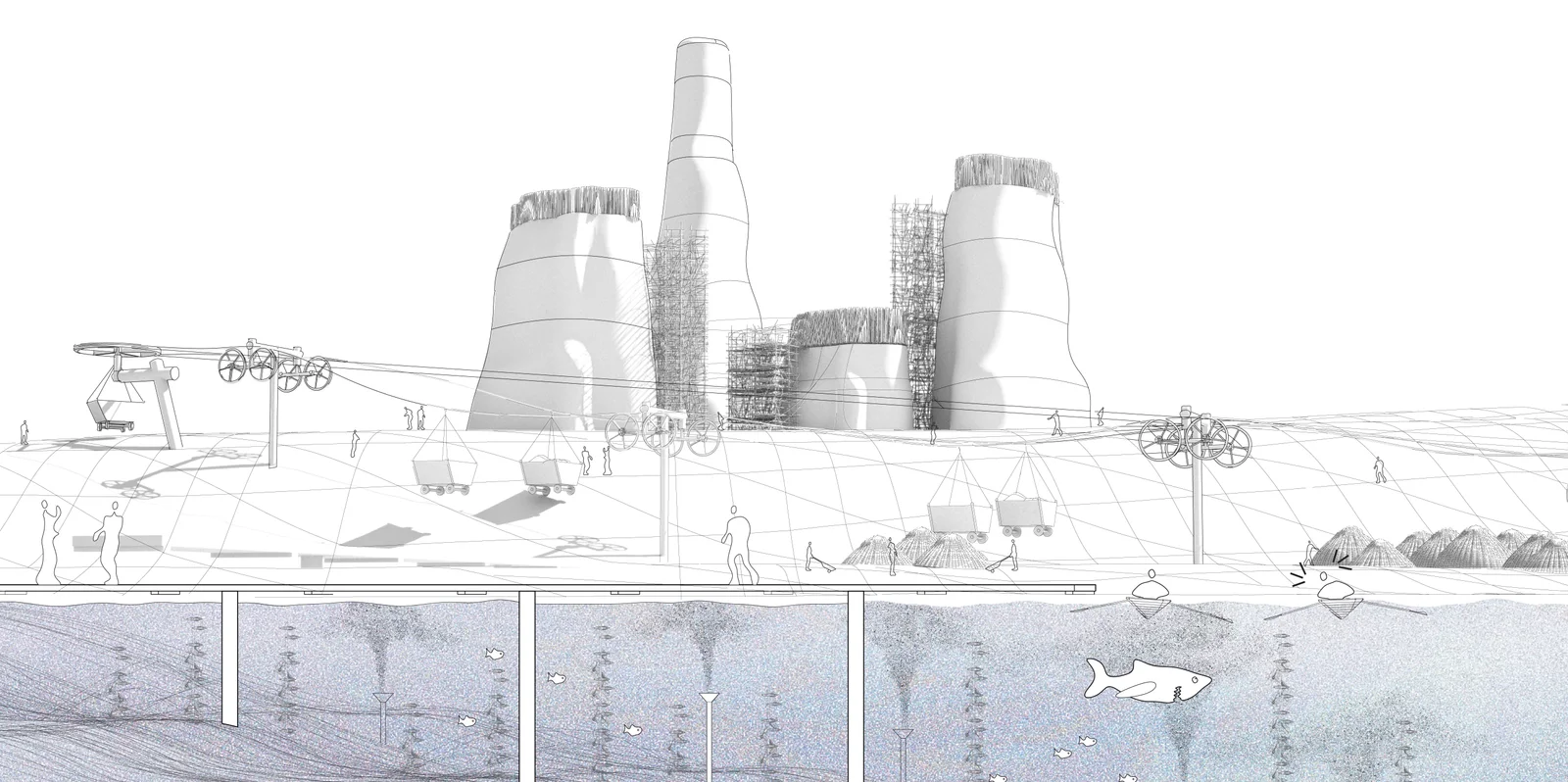
So: deploy oyster colonies along coasts with heavy chemical runoff. Each oyster spends its life cleaning the water. When it dies, its shell is collected, burned to lime, and cast in layers into mineral pinnacles. The towers grow at the pace of the colony's lives and deaths, and stand as a record of the coast that was once damaged.
The chemistry is real. Heated to about 1,500°F, calcium carbonate breaks into calcium oxide and carbon dioxide. Calcium oxide is lime; mixed with water and left to dry it takes carbon dioxide back in and cures into a crystal lattice around the shell aggregate. An oyster lives about six years, so if one shell holds roughly an inch of calcite, the volume of a cast tells you how many oysters it took, and how long the colony needed to grow it.
The refugium: a floating chamber where copepods, the plankton oysters eat, are bred and released.
Copepods are tiny crustaceans, too weak to fight a current, so they drift. An oil derrick turns circular motion into a linear pump; the same mechanism here pumps oxygen into a refugium where the copepods breed, so the colony below always has something to eat.
Three plans of the pinnacle site.
The physical work was the landscape and the towers themselves: CNC-milled reliefs of the coast, a model with masts and cables, and cast pinnacles whose surfaces keep the texture of the mold.